
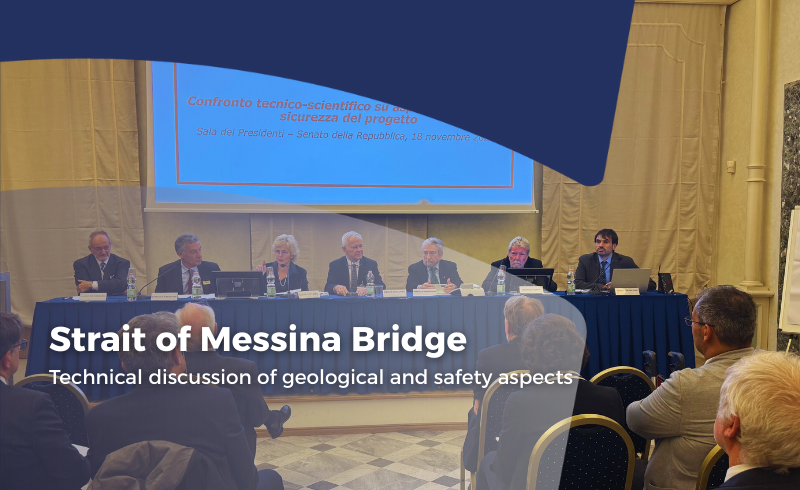
STRAIT OF MESSINA BRIDGE: FULLY FEASIBLE PROJECT, WORKED ON BY A LARGE ITALIAN AND INTERNATIONAL TEAM
Rome, 18 November 2025
The seminar, “The Strait of Messina Bridge: discussion of technical and scientific issues related to the project’s geological and safety aspects”, was held today at the initiative of the Senator for Life, Professor Elena Cattaneo. A number of experts who played a part in studying certain methodological and scientific aspects during preparation of the final design and its update were present. These included Dr. Gianluca Valensise, Professor Iunio Iervolino, Emeritus Professor Giorgio Diana, Professor Fabio Brancaleoni and Professor Alessandro Mandolini, who were present to discuss the observations made by professors Carlo Doglioni, Federico Mazzolani and Mario de Miranda. The seminar was opened by Senator for Life, Professor Elena Cattaneo, together with Stretto di Messina’s CEO, Pietro Ciucci.
The following points were reiterated during the seminar: the decision to build a single-span bridge is based on the fact that the deck will guarantee aerodynamic stability, whilst the difficulties involved in building one or more piers in the sea have not been resolved for several reasons, linked to a series of construction and operational issues connected with the specific conditions in the Strait and the seabed.
In terms of the technological leap represented by the Strait of Messina Bridge, it was noted that the key innovation is the multi-box girder deck that, together with transparent windshields fitted with aerodynamic dampers, ensures that the bridge is fully efficient.
Seismic accelerations for the Strait of Messina Bridge project were checked using the very latest state-of-the-art methods, identical to or more advanced than those used for major international projects. The theory used to calculate the project’s seismic action is the most advanced and rational available. It should be noted that the issue of PGA (peak ground acceleration) is not relevant to the bridge’s seismic dynamics.
The Strait of Messina Bridge has been designed to withstand earthquakes of far greater intensity than those taken as the basis for Italian and international technical standards for other structures.
With regard to active and capable faults, it was shown that there are minor active faults beneath the Strait, above the upper portion of the fault that caused the earthquake of 1908, and that the hypothetical Cannitello Fault is not actually an active fault but a marine terrace (a fossil coastline). The Pezzo Fault is instead an ancient fault forming a coastline, later raised. Neither of the two faults moved in 1908. In terms of slow deformation events, the relative vertical motion at the sites hosting the towers is ~0.1 mm per year, whilst the distance between the two coastlines is growing at a rate of approximately 1 mm per year at the location of the crossing. Neither movement represents a risk for the stability of the bridge.
The Bridge’s final design was produced by a large international team under Italian leadership. The team was made up of leading academics and global experts in the design of suspension bridges and the delivery of major works. Key aspects of the design were also subjected to an independent assessment by leading scientific bodies.
Further information on the above issues is available in specific sections of the Company’s website at strettodimessina.it under File – Nextcloud.